This post may contain affiliate links. If you purchase through these links, GlobeDrones.cc may earn a commission at no extra cost to you. This helps support our reviews, comparisons, and guides.
Flying a drone for the first time feels harder than it really is. The key is not to do too much too soon. Your first goal is not cinematic footage. Your first goal is a safe takeoff, a stable hover, a few simple movements, and a calm landing. That is the foundation everything else builds on.
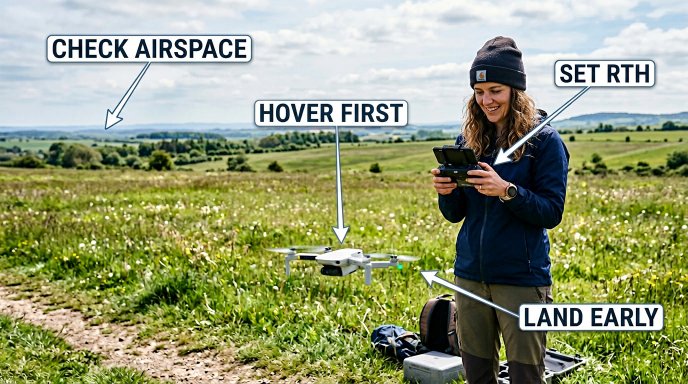
If you are a complete beginner, the safest path is simple: learn the basic controls, choose a wide open legal location, do a proper pre-flight check, and practice a few easy movements before trying anything fancy.
- Quick Answer
- Difficulty, Time Needed, and What You’ll Need
- Key Takeaways
- Before You Fly
- Understand the Rules First
- Choose the Right Practice Spot
- Learn the Basic Controls
- Your First Flight Checklist
- Step-by-Step: Your First Drone Flight
- Step 1: Power on in the right order
- Step 2: Confirm your home point and RTH settings
- Step 3: Take off slowly
- Step 4: Hover at a low safe height
- Step 5: Practice yaw without moving away
- Step 6: Practice short forward and backward moves
- Step 7: Practice left and right slides
- Step 8: Try a simple square pattern
- Step 9: Land early and calmly
- Safety Note: Don’t Trust Return-to-Home Blindly
- What to Do If Something Feels Wrong
- Common Beginner Mistakes
- FAQ
- Bottom Line
Quick Answer
The easiest way to fly a drone for the first time is to keep your first session boring on purpose.
Start in a large open area, use beginner or normal mode, take off slowly, hover at a low height, practice gentle forward/backward and left/right moves, then land before the battery gets low.
Difficulty, Time Needed, and What You’ll Need
Difficulty: Beginner
Time needed: One short setup session plus one short practice session
Best place to practice: A wide open field away from crowds, buildings, trees, and interference sources
What You’ll Need
- your drone
- fully charged flight battery
- fully charged controller
- phone or screen device if your drone uses one
- microSD card if your drone requires one
- propellers installed correctly
- a legal place to fly
- calm weather
- your TRUST certificate and registration if required in the U.S.
Key Takeaways
- Your first flight should be short, simple, and slow.
- Do not start indoors unless your drone is specifically built for that kind of use.
- Check where you can legally fly before you leave home.
- Set your return-to-home behavior and altitude before takeoff.
- Practice hovering before you practice distance or speed.
- Land early instead of trying to “use the whole battery.”
Before You Fly
Before you even power on the drone, make sure you understand the basics of your specific model. Read the manual, update firmware and software, charge everything, inspect the props and body, and make sure your app is not showing warnings. That kind of prep prevents a huge number of beginner problems before they happen.
A smart first-flight routine is simple: check battery power, confirm proper propeller installation, wait until the app shows the drone is ready to go, and make sure the home point is refreshed before takeoff. If you skip those basics, even a good drone can become stressful fast.
Understand the Rules First
If you are flying in the U.S. for fun, FAA recreational rules matter from day one. Recreational flyers need to take the free TRUST test and carry proof while flying. You also need to keep the drone within visual line of sight, stay at or below 400 feet in Class G airspace, give way to other aircraft, and register the drone if it weighs 250 grams or more.
The FAA also recommends using airspace tools like B4UFLY and LAANC-connected services to check where you can fly and whether restrictions apply. If you are outside the U.S., check your own country’s aviation rules before your first flight.
Choose the Right Practice Spot
Your first drone flight should happen in a wide open area, far from crowds, buildings, power lines, and strong interference sources.
This is one of the biggest beginner advantages you can give yourself. A large open field makes every control input feel less dangerous. It also gives you space to recover if you get disoriented. For a first flight, boring airspace is good airspace.
Learn the Basic Controls
You do not need to master everything before takeoff. You just need to understand what each stick does.
Basic movement controls
| Control | What it does | Beginner tip |
|---|---|---|
| Throttle | Makes the drone go up or down | Use tiny inputs |
| Yaw | Rotates the drone left or right | Practice slowly while hovering |
| Pitch | Moves the drone forward or backward | Start with short gentle moves |
| Roll | Moves the drone left or right | Keep it small at first |
The best mindset for first-time pilots
Do not “fly around.” Practice one skill at a time. First hover. Then rotate. Then move forward and stop. Then move backward and stop. Then slide left and right. Slow control beats random confidence every time.
Your First Flight Checklist
Before takeoff, run through this simple list:
- check that you are flying legally in that location
- confirm weather is calm enough for a beginner session
- inspect the props, body, and battery
- confirm controller and drone batteries are charged
- confirm firmware and app are current
- insert your microSD card if needed
- calibrate compass or sensors if your drone requires it
- wait for GPS lock if your model uses GPS
- confirm the home point is correct
- set return-to-home signal loss behavior to RTH if appropriate
- set return-to-home altitude higher than nearby obstacles
- start in beginner or normal mode if available
This checklist may sound like a lot, but it becomes fast after a few flights. It also prevents the most common first-flight mistakes, like weak batteries, wrong settings, bad takeoff spots, or relying on return-to-home without setting it up properly.
Step-by-Step: Your First Drone Flight
Step 1: Power on in the right order
Power on the controller first if your drone uses one, then power on the aircraft. Wait for the app to finish self-checks and make sure there are no major warnings.
Step 2: Confirm your home point and RTH settings
Before takeoff, confirm the drone has recorded the correct home point. Then make sure your return-to-home altitude is high enough to clear nearby obstacles.
Step 3: Take off slowly
Use auto takeoff if your drone has it and you feel more comfortable with that. If you take off manually, raise the drone gently to a low height and stop. Do not shoot upward. Do not start drifting away immediately. The goal is simply to get airborne and stable.
Step 4: Hover at a low safe height
Once you are a little above the ground, hold position and watch how the drone behaves. This is your first real learning moment. You are getting a feel for stick sensitivity, wind, and how the drone reacts when you let go.
Step 5: Practice yaw without moving away
While hovering, gently rotate the drone left and right. This helps you understand orientation, which is one of the biggest beginner challenges. Keep the drone close and low while you do this.
Step 6: Practice short forward and backward moves
Move the drone forward a short distance, stop, then bring it back. Do the same backward. Use tiny stick movements. The goal is control, not range.
Step 7: Practice left and right slides
Now try rolling left and right in short controlled movements. Stop fully between each move. That pause matters because it teaches you to reset instead of overcorrecting.
Step 8: Try a simple square pattern
Once hover, yaw, and basic movement feel manageable, try moving the drone in a small square. This combines your basic controls without asking too much.
Step 9: Land early and calmly
Do not wait until the battery is low or until you feel mentally overloaded. Bring the drone back, hover low over the landing area, and land slowly. Good first sessions often end sooner than beginners expect. That is a win, not a failure.
Safety Note: Don’t Trust Return-to-Home Blindly
Return-to-home is a great backup tool, not a magic button. It depends on the home point being recorded correctly, enough satellite connection, and a safe return altitude. If those are wrong, return-to-home can create new problems instead of solving them.
A smart beginner move is to set return-to-home correctly, understand how to trigger it, and still treat manual recovery and manual landing as your main plan. In other words, know how it works before you need it.
What to Do If Something Feels Wrong
If the drone starts drifting
Pause, reduce movement, and land if needed. Drift can come from wind, poor calibration, or sensor issues.
If you lose video signal
Do not panic. Adjust antenna orientation, check for obstacles between controller and drone, and use return-to-home if connection cannot be resumed.
If you lose control confidence
Stop flying forward, slow down, regain hover, then bring the drone back carefully or land. Beginners usually get into trouble when they keep adding inputs instead of simplifying.
If battery gets low
Do not stretch the session. Low-battery return-to-home exists on many drones, but it is better to land before the drone starts making decisions for you.
Common Beginner Mistakes
1) Flying in the wrong place
Small parks, backyards full of trees, and areas near interference are bad first-flight environments. Open space is safer.
2) Skipping the legal check
You are responsible for knowing where you can and cannot fly. Check your airspace before you head out.
3) Relying on return-to-home without setting it up
If your home point is wrong or your return-to-home altitude is too low, return-to-home can go badly.
4) Trying to learn too fast
Do not jump straight into fast passes, follow modes, or long-distance flying. Hover first. Then basic movement. Then patterns.
5) Using the whole battery on your first flight
First sessions should end while you still feel calm and in control. Landing early is smart pilot behavior.
FAQ
Do I need to take a test before flying my drone for fun?
In the U.S., yes. Recreational flyers need to take the free TRUST test and carry proof while flying.
Where should I fly my drone for the first time?
Use a large open legal area away from crowds, buildings, trees, and interference sources.
How high should I fly on my first flight?
Stay low enough to stay comfortable and in control while practicing hover and simple movement. In the U.S., recreational flying in Class G airspace must stay at or below 400 feet, but your first practice should be much lower than that.
Should I use auto takeoff?
Yes, if your drone offers it and it helps reduce stress. There is nothing wrong with using beginner-friendly features on day one.
Should I fly indoors first?
Usually no. Unless the drone is specifically suited for that environment, indoor spaces add walls, ceilings, and tight margins that make first flights harder.
What is the first skill I should practice?
Hovering. After that, gentle yaw, short forward/backward moves, and short left/right moves.
Can I trust return-to-home completely?
No. It is a useful backup feature, but you need a correct home point, enough GPS, and a safe return altitude first.
Bottom Line
If you want to know how to fly a drone for the first time, the answer is simple: slow down, set up properly, and make your first session smaller than your ego wants it to be. Fly in an open legal area, check your settings, confirm your home point, hover first, move gently, and land early. That is how confident pilots are built.
A good first flight is not impressive. It is calm, safe, and repeatable. That is exactly what you want.