This post may contain affiliate links. If you purchase through these links, GlobeDrones.cc may earn a commission at no extra cost to you. This helps support our reviews, comparisons, and guides.
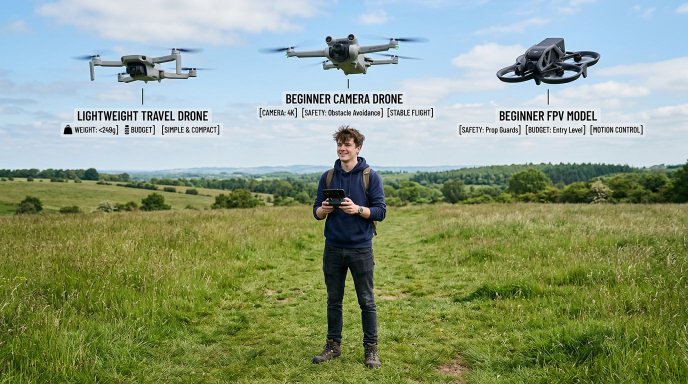
If you’re trying to figure out how to choose your first drone, the easiest approach is this: buy for your real use case, not the biggest spec sheet. Most beginners do best with a drone that is easy to fly, stable in the air, simple to carry, and packed with safety features like GPS stabilization and return-to-home.
- Quick Answer
- Key Takeaways
- Why Choosing Your First Drone Feels Confusing
- The Simple Way to Pick the Right First Drone
- How to Choose Your First Drone Based on What Actually Matters
- Beginner-First Comparison Table
- Real-World Beginner Examples
- Common Mistakes and Myths
- What to Do Before Your First Flight
- FAQ
- Bottom Line
Quick Answer
The best first drone is usually not the fastest or most expensive one.
It’s the one that matches your budget, your skill level, and what you actually want to do:
- Want easy travel content? Choose a light, simple camera drone.
- Want the lowest stress? Choose a model with strong stabilization and return-to-home.
- Want safer learning? Look for propeller protection, beginner modes, and obstacle sensing.
- Want to stay simpler on U.S. rules? A sub-250g drone can reduce hassle for purely recreational flying, though you still need to follow FAA rules and take TRUST for recreational use.
Key Takeaways
- Start with your purpose: fun flying, travel videos, family memories, or learning FPV.
- For most beginners, ease of use beats raw power.
- Safety features matter more than advanced camera specs at the start.
- Weight matters because 250g is an important FAA registration threshold for U.S. recreational flyers.
- Budget for the full setup, not just the drone.
- Don’t buy a drone that pushes you into complexity you’re not ready for.
Why Choosing Your First Drone Feels Confusing
The drone market makes everything sound important. You’ll see 4K, 48MP, obstacle avoidance, subject tracking, FPV, follow-me, long range, and pro-level video features everywhere. The problem is that beginners usually don’t need the most advanced drone. They need the one that helps them learn safely and enjoy flying enough to keep going.
That’s also why many buying guides for new pilots keep coming back to the same themes: ease of use, safety, stability, and lower stress. Beginner-friendly recommendations often highlight return-to-home, collision sensing, protected props, stable hovering, and ready-to-fly setups rather than extreme speed or pro-level manual control.
The Simple Way to Pick the Right First Drone
Here’s the easiest framework:
Pick your first drone by answering four questions:
- What do you want to do with it?
- How much do you want to spend all-in?
- How easy do you want the learning curve to be?
- Do you want a drone that is simple to travel with and easier to keep legal?
A smart way to think about it is to start with your interests, what you want to film, how serious you are about editing, and your budget. Your first drone should fit your style of use, not somebody else’s wishlist.
In plain English
- If you want simple flying and easy content, buy a simple camera drone.
- If you want to learn cinematic flying later, don’t start with the hardest platform.
- If you mainly want fun, don’t overpay for pro features.
- If you’re nervous about crashing, choose the safest and most forgiving setup you can afford.
How to Choose Your First Drone Based on What Actually Matters
1) Purpose comes first
Before you compare models, decide what kind of beginner you are.
| Your main goal | What to prioritize | What matters less |
|---|---|---|
| Casual fun flying | Simplicity, durability, low stress | Pro video specs |
| Travel content | Light weight, foldability, easy setup | Extreme speed |
| Family / social media clips | Good auto modes, decent camera, stable hover | Manual pro controls |
| Learning photography | Better sensor, stable gimbal, reliable app | Tiny toy-drone pricing |
| FPV curiosity | Beginner FPV kit, protected design, training feel | Traditional camera-drone features |
If your goal is simple memories and easy flying, a safe, portable camera drone makes more sense than a complicated FPV setup. If your goal is immersive FPV flying, then a beginner FPV option may be the better first step.
2) Safety features matter more than bragging rights
For a first drone, safety is not boring. Safety is what keeps you in the hobby.
The most helpful beginner features are GPS stabilization, return-to-home, obstacle sensing, propeller protection or guards, altitude limits, and automated modes that reduce pilot error.
Beginner rule: if you must choose between a slightly better camera and a much easier flying experience, choose the easier flying experience.
3) Don’t ignore weight
In the U.S., weight matters right away.
FAA guidance says recreational flyers must register drones that weigh 250 grams (0.55 lb) or more. Recreational flyers also need to take the free TRUST test and carry proof while flying.
That doesn’t mean every beginner must buy under 250g. It just means lighter drones can be simpler for some new pilots. If you want an easier travel-friendly setup with fewer headaches, sub-250g options are worth a hard look. But if you care more about wind performance, stronger cameras, or more advanced features, a heavier drone may still be the better choice.
4) Budget for the full setup
A lot of first-time buyers only budget for the drone body. That is a mistake.
Your real first-drone budget often includes:
- extra batteries
- spare props
- a memory card
- a carrying case
- prop guards if supported
- optional care plan or insurance
- landing pad or small accessories
Don’t think only about the drone itself. Think about the total beginner setup and what helps you actually fly more often.
5) Battery life matters, but not in the way beginners think
Beginners often chase the biggest flight-time number on the box.
That number is useful, but it’s not the only thing that matters. A drone with “enough” battery life and better stability is usually a smarter first choice than one with a longer claimed time but a steeper learning curve.
For most beginners, the practical move is buying at least one extra battery rather than obsessing over the last few minutes in the spec sheet.
6) Camera quality should match your actual output
If you mainly post to Instagram, TikTok, YouTube Shorts, or send clips to friends, you probably do not need the most advanced camera drone on day one.
What you do need is:
- reliable stabilization
- decent video quality
- easy transfer to your phone
- simple shooting modes
- a camera good enough that your results look clean without heavy editing
New pilots who want simple, usable footage should not overspend for pro workflows they may never use.
7) Beginner-friendly controls are a huge deal
Some drones are technically excellent, but not emotionally beginner-friendly.
What makes a drone feel beginner-friendly?
- it hovers predictably
- takeoff and landing feel easy
- the app is clear
- return-to-home is easy to trigger
- automated modes reduce stress
- the controller doesn’t feel confusing
- setup doesn’t become a project every time
That’s why beginner roundups often recommend drones that are ready to fly out of the box and avoid steep setup requirements.
Beginner-First Comparison Table
| Factor | Best beginner choice | Why it helps |
|---|---|---|
| Ease of flight | Stable GPS camera drone | Less panic, easier learning |
| Safety | Return-to-home + obstacle sensing + prop protection | Fewer crashes and safer practice |
| Weight | Under 250g if possible for simple recreational start | Important FAA threshold in the U.S. |
| Camera | Good stabilized 4K is enough for most beginners | Better than chasing pro specs |
| Portability | Small, folding, easy to pack | You’ll actually bring it with you |
| Budget | Mid-range beginner setup with extra battery | Better experience than bare-minimum purchase |
| Learning curve | Auto modes, simple app, clear controls | Builds confidence faster |
Real-World Beginner Examples
Example 1: “I want a drone for travel and vacations”
You should focus on low weight, easy setup, good stabilization, and quick sharing. This type of buyer usually does best with a compact camera drone, not a complicated FPV platform.
Example 2: “I mostly want fun and low stress”
You want something simple, forgiving, and safe. Look hard at prop protection, automated takeoff/landing, and clear beginner modes. Low-stress flying features matter more than flashy specs.
Example 3: “I care most about camera quality”
You may need to spend more, but be honest with yourself. If you’re new, a slightly less advanced camera on a more forgiving drone may lead to better real-world results because you’ll actually feel comfortable flying it.
Example 4: “I want FPV because it looks exciting”
That’s fair, but don’t confuse “cool” with “best first drone for everyone.” FPV is its own category and asks for a different kind of flying experience. If FPV is truly your goal, buy a beginner FPV setup on purpose. If your real goal is easy photos and travel clips, don’t start there.
Common Mistakes and Myths
Mistake 1: Buying for specs instead of use case
A giant spec sheet won’t help if the drone feels stressful to fly.
Mistake 2: Ignoring the legal side
Even beginners flying just for fun need to know the rules. In the U.S., recreational pilots must take TRUST, follow airspace rules, keep visual line of sight, and usually stay at or below 400 feet in Class G airspace.
Mistake 3: Thinking “under 250g” means “no rules”
That is false. The 250g threshold affects registration for recreational flyers, but it does not remove other operating rules.
Mistake 4: Buying too advanced, too soon
A harder drone can slow your progress because you spend all your energy managing the drone instead of learning good habits.
Mistake 5: Underestimating wind
Lighter drones are easier to carry, but they can be more affected by wind.
Mistake 6: Skipping the extra battery
One battery often means one short session and a lot of waiting.
Mistake 7: Flying the first time in the wrong place
Your first flights should happen in a wide-open legal area, not a cramped backyard full of trees, wires, and pressure.
What to Do Before Your First Flight
Here’s the smartest beginner checklist:
- Take TRUST if you’re flying recreationally in the U.S.
- Check whether your drone needs FAA registration at 250g or above for recreational use.
- Read the manual, especially return-to-home, battery, and emergency procedures.
- Update firmware before your first serious flight.
- Practice in a large open area with low wind.
- Use beginner or normal mode first.
- Test takeoff, hover, slow turns, and landing before trying cinematic shots.
- Know your return-to-home settings before you need them.
FAQ
What is the best type of first drone for most people?
For most people, it’s a beginner-friendly GPS camera drone with stable hovering, return-to-home, and simple controls.
Should my first drone be under 250g?
Not always, but it’s worth considering. In the U.S., 250g is a key recreational registration threshold.
Do I need obstacle avoidance on my first drone?
It’s not mandatory, but it can reduce stress and help new pilots avoid simple mistakes.
Is a toy drone a good first drone?
It can be fine for pure fun indoors, but many beginners outgrow toy drones quickly if they really want outdoor flying, good stability, or usable camera footage.
Should beginners buy FPV first?
Only if FPV is your real goal. If you mostly want easy photos, travel shots, and low-stress flying, a standard camera drone is usually the better first choice.
Do I need to register my first drone?
In the U.S., recreational flyers must register drones that weigh 250g or more.
Do I need a license to fly my first drone for fun?
For U.S. recreational flying, you need to take TRUST and carry proof. That is different from Part 107, which applies to most non-recreational operations.
What is the most important beginner feature?
For most new pilots, it’s a mix of stable hovering, return-to-home, and easy controls.
How much should I spend on my first drone?
Spend enough to get a stable, reliable experience. The cheapest option is not always the best value if it makes learning frustrating.
Is the best first drone always the one with the best camera?
No. The best first drone is the one you can fly confidently, safely, and often.
Bottom Line
If you’re wondering how to choose your first drone, focus on fit, not hype. Your first drone should match your real goal, keep the learning curve manageable, and help you fly safely and confidently. For most beginners, that means prioritizing ease of use, safety features, portability, and realistic total cost over chasing the most advanced camera or the fastest flight performance.
A great first drone is the one that gets you in the air regularly, helps you avoid beginner mistakes, and gives you enough room to grow without overwhelming you on day one. Before you buy, check the legal basics, especially TRUST, airspace awareness, and the 250g registration threshold if you’re in the U.S.will set the stage for countless adventures ahead.