This post may contain affiliate links. If you purchase through these links, GlobeDrones.cc may earn a commission at no extra cost to you. This helps support our reviews, comparisons, and guides.
- Quick Answer
- What GPS Does On A Beginner Drone
- What Optical Flow Does On A Beginner Drone
- The Big Difference
- Why GPS Is Usually Better For Beginners
- Where Optical Flow Wins
- Optical Flow’s Weaknesses
- Best Case Scenario: A Drone With Both
- Which Matters More For Different Types Of Beginners?
- GPS Vs Optical Flow: Side-By-Side
- What Beginners Should Actually Buy
- Final Verdict
- Bottom Line
Quick Answer
For most beginners, GPS is more important than optical flow.
GPS gives a drone the kind of help new pilots notice immediately: more stable hovering outdoors, more reliable position hold, better route awareness, and crucial safety features like Return-to-Home. Optical flow is still useful, but it works more like a close-range helper. It’s best for low-altitude stabilization and indoor or GPS-weak situations, not as a full replacement for GPS.
If you are buying your first drone, the best setup is usually GPS plus optical flow together. If you must choose only one, choose GPS.
What GPS Does On A Beginner Drone
GPS helps a drone understand where it is in the world.
That matters because a beginner drone is much easier to fly when it can:
- hold its position outdoors instead of drifting
- hover more confidently
- record a home point
- use Return-to-Home if signal or battery becomes an issue
- provide a more predictable flying experience
For a new pilot, GPS is one of the biggest confidence-building features you can get. It reduces the “floaty” feeling that cheaper toy drones often have and makes the aircraft feel much more locked in.
Why beginners benefit from GPS
A beginner usually makes small control mistakes. GPS helps smooth those mistakes out by giving the drone a better sense of location. It can’t fix everything, but it makes basic hovering and recovery much easier.
What Optical Flow Does On A Beginner Drone
Optical flow helps a drone understand how it is moving relative to the ground beneath it.
It usually works through downward-facing sensors or cameras that look at surface texture below the drone. Instead of using satellites, it watches the ground and detects motion changes.
That makes optical flow especially helpful for:
- low-altitude hover stability
- indoor flying
- smoother takeoffs and landings
- holding position when GPS is weak or unavailable
- precise short-range positioning near the ground
Optical flow is useful, but it has limits. It depends heavily on what the drone sees below it.
The Big Difference
The easiest way to think about it is this:
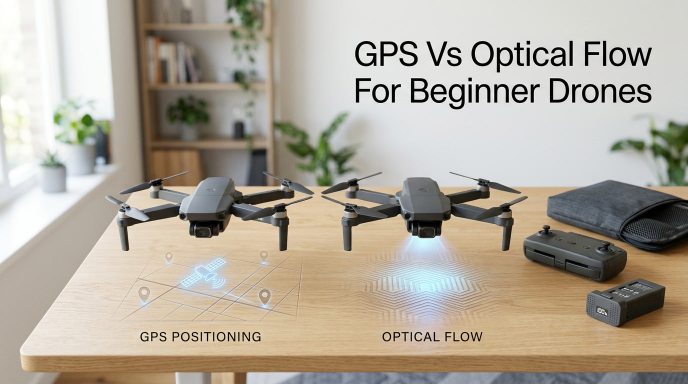
- GPS = global positioning
- Optical flow = local positioning
GPS helps the drone know where it is in a larger outdoor environment.
Optical flow helps the drone stay steady by reading the surface below it at short range.
So they are not really direct replacements. They solve different problems.
Why GPS Is Usually Better For Beginners
If your drone is mainly for parks, travel, vacations, or learning outside, GPS is the bigger win.
1. GPS improves outdoor stability
Outdoors is where most beginners actually fly. GPS is far more important there because it helps the drone resist drifting and maintain position.
2. GPS enables Return-to-Home
This is one of the best beginner safety features. If the drone loses connection, gets too far away, or runs low on battery, GPS-based Return-to-Home can help bring it back.
Optical flow does not replace that.
3. GPS makes the drone feel smarter
A GPS-equipped drone usually feels more controlled, more dependable, and less stressful to fly than a non-GPS drone.
4. GPS matters more once the drone gains height
Optical flow is most useful near the ground. GPS stays relevant throughout the whole outdoor flight.
Where Optical Flow Wins
Optical flow is not the main feature to prioritize, but it definitely has value.
1. Indoor flying
GPS can be weak or unavailable indoors. Optical flow can help the drone hover more steadily when satellite positioning is not practical.
2. Precise low-level hovering
For low-altitude positioning, optical flow can help the drone hold itself nicely over the ground.
3. Takeoff and landing confidence
Many beginner drones feel more controlled near the ground when optical flow is assisting.
4. Backup support
On drones that use both systems, optical flow can complement GPS rather than compete with it.
Optical Flow’s Weaknesses
This is where beginners need to be careful. Optical flow can be impressive, but it is also easier to confuse.
It may struggle when flying over:
- very dark surfaces
- very bright surfaces
- reflective ground
- glass or water
- repetitive patterns
- low-texture ground
- moving surfaces or environments
- poor lighting
So while optical flow sounds advanced, it is not magic. If the drone cannot clearly read the ground beneath it, performance can drop fast.
That is one reason GPS remains the better core feature for beginner drones.
Best Case Scenario: A Drone With Both
The ideal beginner setup is GPS plus optical flow, not GPS versus optical flow as an either-or choice.
A drone with both systems can be better because:
- GPS helps outdoors and with navigation safety
- optical flow helps at low altitude and in close-range stabilization
- the overall flight experience feels smoother and more forgiving
This is the sweet spot for many modern beginner camera drones.
Which Matters More For Different Types Of Beginners?
Casual outdoor beginner
Choose GPS first.
If you mostly want to fly in open areas, parks, beaches, or while traveling, GPS matters more.
Indoor learner
Optical flow becomes more useful here, but beginner indoor flying is still tricky. If indoor use is a major priority, optical flow helps more than it would outdoors.
Travel beginner
GPS still wins. Travel users usually want easy outdoor hovering, map awareness, and Return-to-Home.
Social-content beginner
Best option is both. GPS helps with safer outdoor capture, while optical flow can improve close-range control.
Toy-drone upgrader
If you are moving up from a cheap non-GPS drone, GPS will feel like the biggest upgrade by far.
GPS Vs Optical Flow: Side-By-Side
| Feature | GPS | Optical Flow |
|---|---|---|
| Best for outdoor flying | Excellent | Limited |
| Best for indoor flying | Weak | Better |
| Helps Return-to-Home | Yes | No |
| Helps low-altitude precision | Somewhat | Very good |
| Works over difficult surfaces | More reliable overall | Can struggle |
| Best for beginners overall | Yes | Secondary |
| Best used alone | Yes, if necessary | Not ideal |
| Best used together | Yes | Yes |
What Beginners Should Actually Buy
If you are shopping for your first drone, here is the practical advice:
Choose a GPS drone if:
- you will mostly fly outdoors
- you want safer recovery features
- you want less drifting
- you want a more confidence-friendly first experience
Choose a drone with optical flow too if:
- you want smoother low-altitude hovering
- you may fly indoors sometimes
- you want more refined short-range stability
Avoid relying on optical flow alone if:
- you want serious outdoor use
- you need dependable positioning at height
- you care about Return-to-Home and better safety behavior
Final Verdict
For beginner drones, GPS is the feature that matters more.
Optical flow is useful, and it can make a drone feel better near the ground or indoors, but it is not the core technology that makes a beginner drone truly forgiving. GPS is what gives new pilots the biggest upgrade in confidence, safety, and outdoor usability.
So the simple answer is:
- Best overall for beginners: GPS
- Best supporting feature: Optical flow
- Best setup of all: GPS + optical flow together
If you are choosing your first real camera drone, prioritize GPS first and treat optical flow as a bonus that improves the overall experience.
Bottom Line
- GPS is better for most beginners
- Optical flow is helpful, but secondary
- Both together is the ideal combo
- If you fly outdoors, GPS matters much more
- If you fly indoors or close to the ground, optical flow becomes more useful