This post may contain affiliate links. If you purchase through these links, GlobeDrones.cc may earn a commission at no extra cost to you. This helps support our reviews, comparisons, and guides.
- Quick Answer
- First, a Quick Clarification
- Foldable vs Mini Drones at a Glance
- Why Mini Drones Usually Win for Travel
- Why Larger Foldable Drones Still Matter
- Portability: Mini Drones Win
- Camera Quality: Foldable Drones Win
- Travel Convenience: Mini Drones Win Again
- Wind, Range, and Confidence: Foldable Drones Usually Win
- Battery Life: Slight Edge to Foldable, But It Depends
- Safety Features: Depends on the Model
- Best Choice for Different Types of Travelers
- Best Real-World Examples
- So Which Is Better for Travel?
- Final Verdict
- Pros and Cons Snapshot
Quick Answer
For most travelers, mini drones are the better choice. They are lighter, easier to pack, easier to carry all day, and usually simpler to justify bringing on trips. If your main goal is convenience, portability, and casual travel content, a mini drone is usually the smarter buy.
But foldable drones can still be the better travel option for some people. If you care more about image quality, stronger wind performance, longer-range shooting confidence, and more cinematic flexibility, a larger foldable drone can absolutely be worth the extra size and weight.
The short version is simple:
- Choose a mini drone if you want the easiest, lightest, most travel-friendly option.
- Choose a larger foldable drone if you want better footage and are willing to carry more gear.
First, a Quick Clarification
This topic can get confusing because a lot of mini drones are also foldable.
So for this guide, the comparison is really:
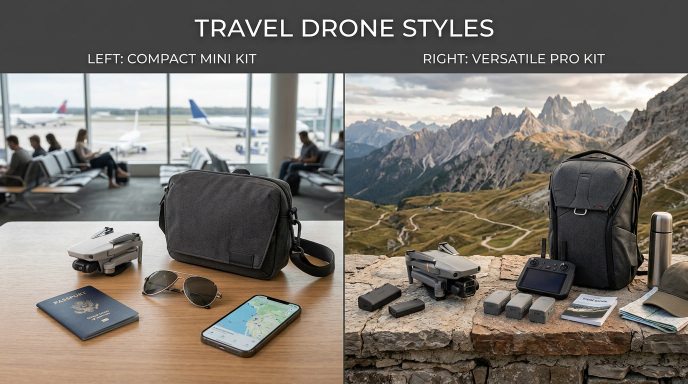
- Mini drones: small, ultralight drones, often under 250 g
- Larger foldable drones: traditional folding drones that pack down for transport, but are still bigger and heavier than mini models
In other words, this is not really “folding arms versus not folding arms.” It is more about compact ultralight travel drones versus bigger foldable camera drones.
Foldable vs Mini Drones at a Glance
| Category | Mini Drones | Larger Foldable Drones |
|---|---|---|
| Best for | Most travelers | Creators who prioritize image quality |
| Portability | Excellent | Good, but less effortless |
| Weight | Usually much lighter | Noticeably heavier |
| Packing convenience | Easy to slip into a small bag | Needs more deliberate packing |
| Camera quality | Good to very good | Usually better |
| Wind performance | More limited | Usually stronger |
| Battery life | Good | Often better |
| Travel spontaneity | Excellent | Good, but less casual |
| Best overall travel pick | Mini drones | Foldable drones only for specific needs |
Why Mini Drones Usually Win for Travel
For travel, convenience matters more than most people expect.
A drone can have amazing specs, but if it feels too bulky, too annoying to pack, or too precious to carry all day, it often gets left behind in the hotel room. That is why mini drones usually win for real-world travel.
1. They are easier to pack
Mini drones take up less space in a backpack, sling, or camera cube. That matters when you are already carrying chargers, clothes, passports, toiletries, and maybe another camera.
2. They are easier to justify bringing
A mini drone feels like something you can toss into your bag “just in case.” A bigger foldable drone often feels like a piece of gear you must intentionally build the day around.
3. They work better for casual travel use
A lot of travel drone footage happens in short windows:
- sunrise at a viewpoint
- a quiet beach stop
- a scenic overlook during a road trip
- a quick golden-hour city shot
Mini drones are better for these moments because they create less friction.
4. They are better for people who walk a lot
If you are traveling through cities, hiking, moving between trains, or changing hotels frequently, every bit of saved weight matters.
5. They are often the smarter all-around travel buy
For most people, a drone like the DJI Mini 4 Pro, DJI Mini 3, DJI Flip, or even DJI Neo is simply more realistic for actual travel than something larger.
Why Larger Foldable Drones Still Matter
Mini drones are better for most travelers, but larger foldable drones still have clear advantages.
1. Better image quality
A larger foldable drone often gives you:
- a bigger sensor
- better dynamic range
- more detailed footage
- better low-light performance
- more professional-looking results
That is a real difference if you care about cinematic travel footage instead of just social content.
2. Better wind handling
Heavier foldable drones are usually more stable in wind. If you travel to coastlines, mountains, cliffs, or open landscapes, that matters.
3. More creative flexibility
Many larger foldable drones have better camera systems. A model like the DJI Air 3S gives you more than just a single standard perspective. That makes your travel footage feel more polished and less repetitive.
4. Better fit for serious creators
If you are a travel filmmaker, YouTuber, or photographer building more deliberate edits, the jump in quality can absolutely justify the larger size.
So while mini drones win on convenience, larger foldable drones win on performance.
Portability: Mini Drones Win
This is the easiest category to call.
Mini drones are simply better for portability.
A DJI Mini 4 Pro or DJI Mini 3 is far easier to live with on a trip than a larger foldable drone like the DJI Air 3S. Even when both drones technically fold, the mini model takes up less room, weighs less, and feels less like dedicated camera equipment.
If portability is your top priority, mini drones are the better answer almost every time.
Best for portability
- DJI Mini 4 Pro
- DJI Mini 3
- DJI Flip
- DJI Neo
Less ideal for pure portability
- DJI Air 3S
- other larger foldable travel drones
Camera Quality: Foldable Drones Win
If your question is purely about image quality, larger foldable drones usually win.
A drone like the DJI Air 3S has a stronger camera system than a typical mini drone. It offers better sensor size, more framing flexibility, stronger overall image depth, and a more premium look to the footage.
Mini drones can still look excellent, especially in good daylight, but foldable drones usually have the edge when you really care about:
- more cinematic travel edits
- stronger low-light performance
- more detailed landscape footage
- more professional-looking results
If image quality is your top priority, foldable drones make the stronger argument.
Travel Convenience: Mini Drones Win Again
This category is different from pure portability.
A drone can fit in your bag but still be annoying to use. Travel convenience is about how naturally the drone fits into the flow of a trip.
Mini drones usually do this better because they are:
- faster to grab
- less mentally “heavy” to carry
- easier to use spontaneously
- better suited to mixed travel days
That matters because travel is not a studio shoot. It is messy. You are moving, waiting, walking, eating, sightseeing, and managing logistics. Mini drones fit into that reality better.
Wind, Range, and Confidence: Foldable Drones Usually Win
This is where larger foldable drones earn back some ground.
If you travel somewhere with:
- open coastlines
- mountain viewpoints
- windy ridges
- larger landscapes
- more ambitious flying conditions
a bigger foldable drone often feels more planted and confidence-inspiring.
Mini drones have improved a lot, but they still tend to be more limited in windy conditions than larger, heavier aircraft.
So if your travel style includes dramatic landscapes and more demanding shooting conditions, the bigger foldable drone starts to make more sense.
Battery Life: Slight Edge to Foldable, But It Depends
Battery life is not always a landslide win for larger foldable drones anymore, but they still often hold a slight advantage.
For example:
- DJI Air 3S can offer very strong endurance for a travel camera drone
- DJI Mini 3 and Mini 4 Pro also offer excellent flight times
- DJI Neo trades endurance for extreme portability
So the real answer is:
- mini drones are no longer weak here
- larger foldable drones still tend to feel more comfortable for extended shooting sessions
If battery life is a key concern, compare specific models rather than assuming size tells the whole story.
Safety Features: Depends on the Model
This is not a simple category split.
Some mini drones now have excellent sensing and safety features. The DJI Mini 4 Pro, for example, is much more confidence-inspiring than many older travel drones. Meanwhile, some cheaper mini drones and entry-level drones are much more limited.
Larger foldable drones often still feel safer overall because they combine more advanced sensing with stronger flight behavior, but the gap is not as dramatic as it used to be.
So this category is really model-specific, not just size-specific.
Best Choice for Different Types of Travelers
Choose a mini drone if you are:
- a casual traveler
- a vacation photographer
- a city-break traveler
- a backpacker
- someone who values small size above all else
- someone who wants a drone they will actually carry every day
Choose a larger foldable drone if you are:
- a serious content creator
- a travel filmmaker
- a YouTuber shooting polished edits
- someone who prioritizes image quality over convenience
- someone traveling specifically to shoot landscapes or cinematic footage
Best Real-World Examples
Best mini drone for most travelers
DJI Mini 4 Pro
This is the easiest recommendation for most people because it gives you travel-friendly size without feeling too compromised.
Best value mini travel drone
DJI Mini 3
A great option if you want strong travel performance without paying for a higher-end model.
Best ultra-light casual travel drone
DJI Neo
Best if your top priority is carry-everywhere simplicity.
Best social-first mini option
DJI Flip
Great for casual creators, short-form travel content, and easy everyday carry.
Best larger foldable travel drone
DJI Air 3S
Best if you want stronger image quality, better camera flexibility, and more cinematic results.
So Which Is Better for Travel?
For most people, mini drones are better for travel.
They are easier to pack, easier to carry, easier to use casually, and more likely to come with you every day. And that matters more than having the absolute best image quality if the larger drone spends half the trip in your room.
But if you are traveling specifically to shoot high-quality content and you are willing to carry more gear, then a larger foldable drone may absolutely be the better tool.
So the honest answer is:
- Mini drones are better for travel convenience
- Foldable drones are better for travel performance
And for most normal travelers, convenience wins.
Final Verdict
If your goal is to bring a drone on trips without overcomplicating your bag, your schedule, or your daily carry, mini drones are the better travel choice.
If your goal is to get the best possible footage and you are comfortable carrying something larger, a bigger foldable drone is worth it.
For most travelers, start with a mini drone such as the DJI Mini 4 Pro or DJI Mini 3. Move to a larger foldable drone like the DJI Air 3S only if you know you will genuinely benefit from the extra performance.
That is the real dividing line: mini drones are better for travelers, while foldable drones are better for creators who travel.
Pros and Cons Snapshot
Mini Drones
Pros
- Easier to pack
- Easier to carry all day
- Better for casual travel
- More spontaneous and convenient
- Often enough for most travelers
Cons
- Usually less capable in wind
- Camera quality may be lower than larger drones
- Less cinematic flexibility on some models
Larger Foldable Drones
Pros
- Better image quality
- Better wind handling
- Stronger overall performance
- Better for serious travel filming
Cons
- Heavier
- Bulkier
- Less casual to pack
- More likely to be left behind on light travel days